
Home / Search / The Art of ARM Assembly, Volume 1: 64-Bit ARM Machine Organization and Programming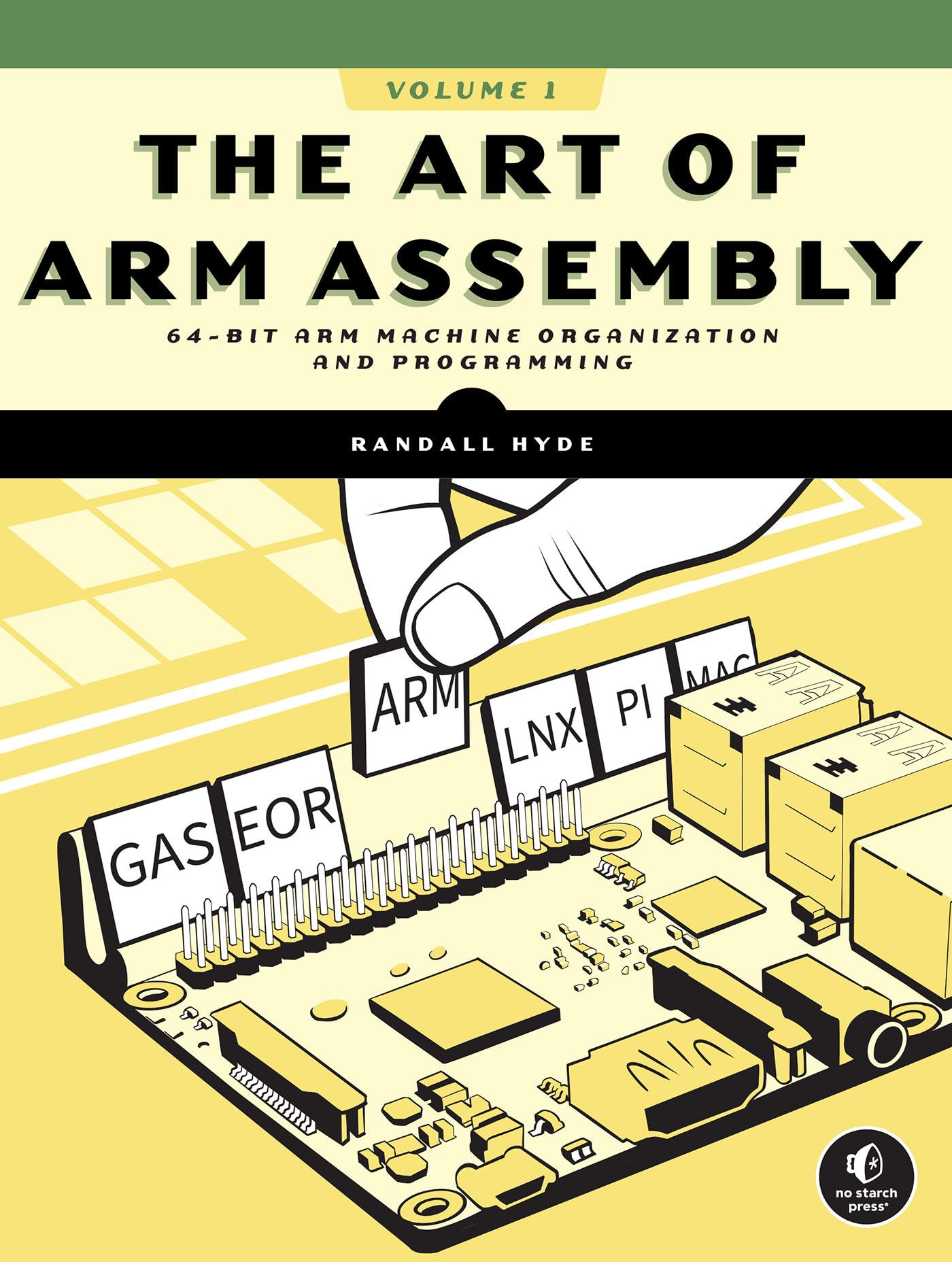
- ISBN-13 · 9781718502826
- ISBN-10 · 1718502826
- Publisher · No Starch Press
- Format · paperback, 1064 pages
- Published · 2025
- Language · English
The Art of ARM Assembly, Volume 1: 64-Bit ARM Machine Organization and Programming
Rent this book
Free return shipping includedTotal rental price$26.00
Please Note: Rental books are typically used and do not come with any unused access code cards.
Return by 2026-12-08. Prepaid return label included; extend at any point for the difference in price.
Buy from a seller
No copies for sale right now — but you can rent it above.
Check back soon — sellers list new copies every day.
About this book
Modern Instructions for 64-Bit ARM CPUs
Building on Randall Hyde’s iconic series, The Art of ARM Assembly delves into programming 64-bit ARM CPUs—the powerhouses behind iPhones, Macs, Chromebooks, servers, and embedded systems.
Following a fast-paced introduction to the art of programming in assembly and the GNU Assembler (Gas) specifically, you’ll explore memory organization, data representation, and the basic logical operations you can perform on simple data types. You’ll learn how to define constants, write functions, manage local variables, and pass parameters efficiently. You’ll explore both basic and advanced arithmetic operations, control structures, numeric conversions, lookup tables, and string manipulation—in short, you’ll cover it all.
You’ll also dive into ARM SIMD (Neon) instructions, bit manipulation, and macro programming with the Gas assembler, as well as how to:
Declare pointers and use composite data structures like strings, arrays, and unions Convert simple and complex arithmetic expressions into machine instruction sequences Use ARM addressing modes and expressions to access memory variables Create and use string library functions and build libraries of assembly code using makefiles
This hands-on guide will help you master ARM assembly while revealing the intricacies of modern machine architecture. You’ll learn to write more efficient high-level code and gain a deeper understanding of software-hardware interactions—essential skills for any programmer working with ARM-based systems.