
Home / Search / Domain-Specific Small Language Models: Efficient AI for local deployment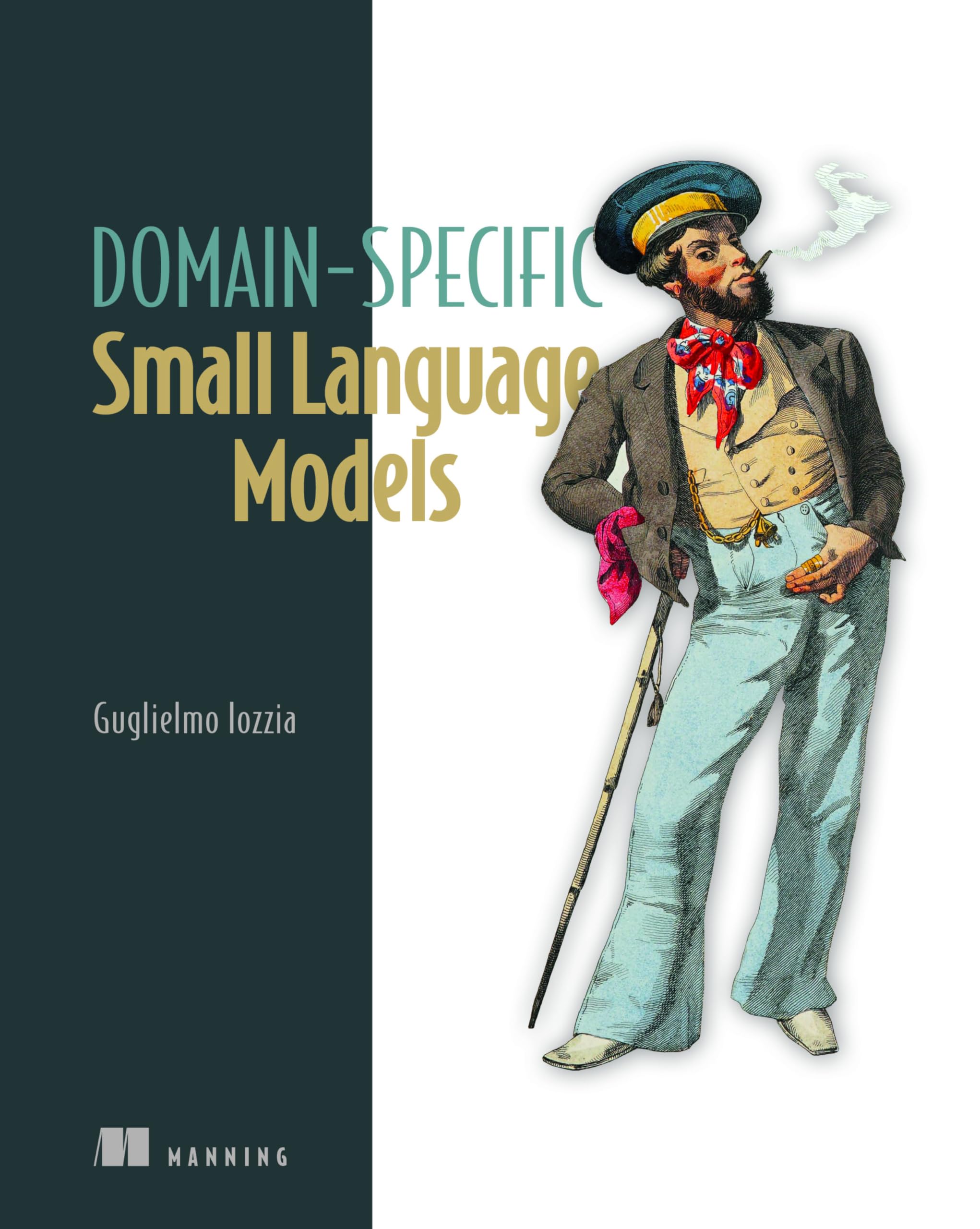
- ISBN-13 · 9781633436701
- ISBN-10 · 1633436705
- Publisher · Manning Publications
- Format · paperback, 376 pages
- Published · 2026
- Language · English
Domain-Specific Small Language Models: Efficient AI for local deployment
Buy from a seller
No copies for sale right now.
Check back soon — sellers list new copies every day.
About this book
Get the eBook free when you register your print book at Manning.
When you need a language model to respond accurately and quickly about a specific field of knowledge, the sprawling capacity of a LLM may hurt more than it helps. This book teaches you to build generative AI models optimized for specific fields.
Perfect for cost- or hardware-constrained environments, Small Language Models (SLMs) train on domain specific data for high-quality results in specific tasks. In this book you’ll develop SLMs that can generate everything from Python code to protein structures and antibody sequences—all on commodity hardware.
In Domain-Specific Small Language Models you’ll discover:
• Model sizing best practices
• Open source libraries, frameworks, utilities and runtimes
• Fine-tuning techniques for custom datasets
• Hugging Face’s libraries for SLMs
• Running SLMs on commodity hardware
• Model optimization or quantization
Foreword by Matthew R. Versaggi.
About the technology
Small-footprint language models trained on custom data sets and hosted locally can perform as well as large generalist models in speed and accuracy, often at a fraction of the cost. Domain-Specific Small Language Models shows you how to build privacy-preserving and regulation-compliant SLMs for agentic systems, specialist applications, and deployment on the edge.
About the book
This is a practical book that shows you how to adapt pretrained open source models to your domain using transfer learning and parameter-efficient fine-tuning. You’ll learn to minimize cost through optimization and quantization, develop secure APIs to serve your models, and deploy SLMs on commodity hardware—including small devices. The hands-on examples include integrating SLMs into RAG systems and agentic workflows.
What's inside
• ONNX and other quantization methods
• Integrate SLMs into end-to-end applications
• Deploy SLMs on laptops, smartphones, and other devices
About the reader
For AI engineers familiar with Python.
About the author
Guglielmo Iozzia is a Director of AI and Applied Mathematics at Merck & Co. and a Distinguished Member of the American Society for Artificial Intelligence. He specializes in AI biomedical applications.
The technical editor on this book was Riccardo Mattivi.
Table of Contents
Part 1
1 Small language models
Part 2
2 Tuning for a specific domain
3 End-to-end transformer fine-tuning
4 Running inference
5 Exploring ONNX
6 Quantizing for your production environment
Part 3
7 Generating Python code
8 Generating protein structures
Part 4
9 Advanced quantization techniques
10 Profiling insights
11 Deployment and serving
12 Running on your laptop
13 Creating end-to-end LLM applications
14 Advanced components for LLM applications
15 Test-time compute and small language models