
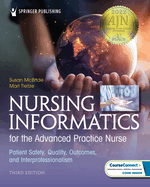
Nursing Informatics for the Advanced Practice Nurse, Third Edition: Patient Safety, Quality, Outcomes, and Interprofessionalism
Rent this book
Free return shipping includedPlease Note: Rental books are typically used and do not come with any unused access code cards.
Buy from a seller
About this book
Awarded first place in the 2022 AJN Book of the Year Awards in Informatics
This award-winning resource uniquely integrates national goals with nursing practice to achieve safe, efficient quality of care through technology management. The heavily revised third edition emphasizes the importance of federal policy in digitally transforming the U.S. healthcare delivery system, addressing its evolution and current policy initiatives to engage consumers and promote interoperability of the IT infrastructure nationwide. It focuses on ways to optimize the massive U.S. investment in HIT infrastructure and examines usability, innovative methods of workflow redesign, and challenges with electronic clinical quality measures (eCQMs). Additionally, the text stresses documentation challenges that relate to usability issues with EHRs and sub-par adoption and implementation. The third edition also explores data science, secondary data analysis, and advanced analytic methods in greater depth, along with new information on robotics, artificial intelligence, and ethical considerations.
Contributors include a broad array of notable health professionals, which reinforces the book's focus on interprofessionalism. Woven throughout are the themes of point-of-care applications, data management, and analytics, with an emphasis on the interprofessional team. Additionally, the text fosters an understanding of compensation regulations and factors.
New to the Third Edition:
- Examines current policy initiatives to engage consumers and promote nationwide interoperability of the IT infrastructure
- Emphasizes usability, workflow redesign, and challenges with electronic clinical quality measures
- Covers emerging challenge proposed by CMS to incorporate social determinants of health
- Focuses on data science, secondary data analysis, citizen science, and advanced analytic methods
- Revised chapter on robotics with up-to-date content relating to the impact on nursing practice
- New information on artificial intelligence and ethical considerations
- New case studies and exercises to reinforce learning and specifics for managing public health during and after a pandemic
- COVID-19 pandemic-related lessons learned from data availability, data quality, and data use when trying to predict its impact on the health of communities
- Analytics that focus on health inequity and how to address it
- Expanded and more advanced coverage of interprofessional practice and education (IPE)
- Enhanced instructor package
Key Features:
- Presents national standards and healthcare initiatives as a guiding structure throughout
- Advanced analytics is reflected in several chapters such as cybersecurity, genomics, robotics, and specifically exemplify how artificial intelligence (AI) and machine learning (ML) support related professional practice
- Addresses the new re-envisioned AACN essentials
- Includes chapter objectives, case studies, end-of-chapter exercises, and questions to reinforce understanding
- Aligned with QSEN graduate-level competencies and the expanded TIGER (Technology Informatics Guiding Education Reform) competencies.