
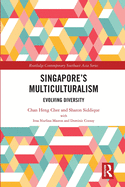
Singapore's Multiculturalism: Evolving Diversity
Rent this book
Free return shipping includedPlease Note: Rental books are typically used and do not come with any unused access code cards.
Buy from a seller
About this book
Since independence in 1965, Singapore has developed its own unique approach to managing the diversity of Race, Religion, Culture, Language, Nationality, and Age among its citizens. This approach is a consequence of many factors, including its very distinct ethnic makeup compared with its neighbours, its ambitions as a globally oriented city-state, and its small physical size. Each of these factors and many others have presented Singapore society with a range of challenges and opportunities, and will in all likelihood continue to do so for the foreseeable future.
In the writing of this book, the author team set themselves the task of projecting the impact of current domestic and international social trends into the future, to anticipate what Singapore society might look like by around 2040. In doing so, they analyse the particular path that Singapore has taken since independence, in comparison with other multicultural societies and with regard to the balance between the necessity of forging a new national identity after British rule and departure from Malaysia, and the need to ensure that Singapore's ethnic minority populations remain socially enfranchised. They further consider how current trends may develop over the next couple of decades, what new challenges this may present to Singapore society, and what might be the likely responses to such challenges. In this book, Singapore is a case study of a global city facing the challenges of developed-world modernity in frequently acute ways.