
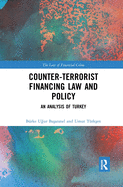
Counter-Terrorist Financing Law and Policy: An Analysis of Turkey
Rent this book
Free return shipping includedPlease Note: Rental books are typically used and do not come with any unused access code cards.
Buy from a seller
About this book
Since the 9/11 attacks the world has witnessed the creation of both domestic and international legal instruments designed to disrupt and interdict the financial activities of terrorists. This book analyses the counter-terrorist financing law (CTF), policy and practice at the national level, focusing on Turkey. The work examines the limits and capabilities of CTF efforts on terrorism threats and determines the effectiveness of CTF efforts in Turkey, a country which has a pivotal role in terms of countering terrorism regionally and internationally.
The Turkish case-study is supported by an empirical study involving 37 semi-structured interviews with CTF practitioners and law enforcement experts with different affiliations and backgrounds. The findings illustrate that Turkey's CTF system has not obtained an adequate level of effectiveness as a result of lack of proper implementation of its policy in the bureaucratic, legal and operational spheres. It is evident that the administrative and legal systems in Turkey are established according to the 'one-size-fits-all' international CTF standards and thus are compliant with the international CTF benchmarks, yet the interviews reveal significant challenges at the implementation level including lack of training and financial security, heavy handed bureaucracy, inadequate coordination and communication between international and national levels.
The book will be an invaluable resource for academics, students and policy-makers working in the areas of financial crime and terrorism.