
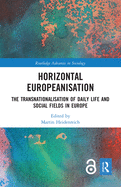
Horizontal Europeanisation: The Transnationalisation of Daily Life and Social Fields in Europe
Rent this book
Free return shipping includedPlease Note: Rental books are typically used and do not come with any unused access code cards.
Buy from a seller
About this book
Chapter 8 of this book is freely available as a downloadable Open Access PDF under a Creative Commons Attribution-Non Commercial-No Derivatives 4.0 license.
https: //tandfbis.s3-us-west-2.amazonaws.com/rt-files/docs/Open+Access+Chapters/9780815392774+_oachapter8.pdf
European integration has transformed the social life of European citizens. Daily life and work no longer take place primarily in a local and national context, but increasingly in a European and transnational frame - a process of 'horizontal Europeanisation' which, while increasing the life chances of European citizens, also brings about conflicts among them. This book focuses on processes of Europeanisation in the academic, bureaucratic, professional and associational field, as well as on the Europeanisation of solidarity, networks and social inequalities. Drawing on detailed empirical studies and attending to the reinforcement of centre‐periphery structures in Europe, it analyses the dynamics of horizontal Europeanisation processes, highlighting the crucial role of national practices and perceptions in a transnational context, as well as the related conflicts between the winners and losers in this process. As such, it will appeal to scholars of sociology and political science with interests in European integration, social change and social stratification.