
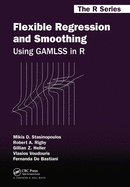
Flexible Regression and Smoothing: Using Gamlss in R
Rent this book
Free return shipping includedPlease Note: Rental books are typically used and do not come with any unused access code cards.
Buy from a seller
About this book
This book is about learning from data using the Generalized Additive Models for Location, Scale and Shape (GAMLSS). GAMLSS extends the Generalized Linear Models (GLMs) and Generalized Additive Models (GAMs) to accommodate large complex datasets, which are increasingly prevalent.
In particular, the GAMLSS statistical framework enables flexible regression and smoothing models to be fitted to the data. The GAMLSS model assumes that the response variable has any parametric (continuous, discrete or mixed) distribution which might be heavy- or light-tailed, and positively or negatively skewed. In addition, all the parameters of the distribution (location, scale, shape) can be modelled as linear or smooth functions of explanatory variables.
Key Features:
- Provides a broad overview of flexible regression and smoothing techniques to learn from data whilst also focusing on the practical application of methodology using GAMLSS software in R.
- Includes a comprehensive collection of real data examples, which reflect the range of problems addressed by GAMLSS models and provide a practical illustration of the process of using flexible GAMLSS models for statistical learning.
- R code integrated into the text for ease of understanding and replication.
- Supplemented by a website with code, data and extra materials.
This book aims to help readers understand how to learn from data encountered in many fields. It will be useful for practitioners and researchers who wish to understand and use the GAMLSS models to learn from data and also for students who wish to learn GAMLSS through practical examples.