
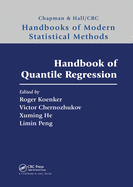
Handbook of Quantile Regression
Rent this book
Free return shipping includedPlease Note: Rental books are typically used and do not come with any unused access code cards.
Buy from a seller
About this book
Quantile regression constitutes an ensemble of statistical techniques intended to estimate and draw inferences about conditional quantile functions. Median regression, as introduced in the 18th century by Boscovich and Laplace, is a special case. In contrast to conventional mean regression that minimizes sums of squared residuals, median regression minimizes sums of absolute residuals; quantile regression simply replaces symmetric absolute loss by asymmetric linear loss.
Since its introduction in the 1970's by Koenker and Bassett, quantile regression has been gradually extended to a wide variety of data analytic settings including time series, survival analysis, and longitudinal data. By focusing attention on local slices of the conditional distribution of response variables it is capable of providing a more complete, more nuanced view of heterogeneous covariate effects. Applications of quantile regression can now be found throughout the sciences, including astrophysics, chemistry, ecology, economics, finance, genomics, medicine, and meteorology. Software for quantile regression is now widely available in all the major statistical computing environments.
The objective of this volume is to provide a comprehensive review of recent developments of quantile regression methodology illustrating its applicability in a wide range of scientific settings.
The intended audience of the volume is researchers and graduate students across a diverse set of disciplines.