
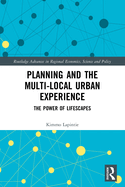
Planning and the Multi-local Urban Experience: The Power of Lifescapes
Rent this book
Free return shipping includedPlease Note: Rental books are typically used and do not come with any unused access code cards.
Buy from a seller
About this book
The starting point of this book is the observation that there is a discrepancy between the lived reality of human beings and the fabricated, planned, and governed 'reality' of the state apparatus at both the local and national level.
The book posits multi-locality as an emerging spatial configuration. The author draws from various theoretical sources, such as Deleuze and Guattari's concepts of state or royal science, the Nietzschean critique of idealism, Hägerstrnad's time-geography, Hintikka's theory of modalities, Lefebvre's urban society, Castel's network society, Foucault's concept of heterotopia, and Bhaskar's and Sartre's theories of presence and absence. He also discusses the implications of Faludi's post-territorialist critique of planning and governance, and of the failure to operationalise the concept quantitively, basing his arguments in the lived experiences of multi-locals as well.
The novelty of the book is how it analyses multi-locality from such a wide theoretical perspective: what is the nature and meaning of the different multiple and coexistent places for people, and how is this spatial transformation related to their mobility, everyday practices, and work. How does the presence and absence of places form their identity and their citizenship? He also addresses the inconsistency between multi-locality and traditional statistics and the planning and governance practices based on the assumption of unilocality and discusses the implications of this incongruity.
The book will be of interest to scholars in urban studies and planning theory, as well as practitioners developing more adequate practices replacing outdated ones.