
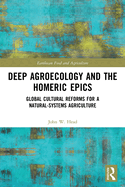
Deep Agroecology and the Homeric Epics: Global Cultural Reforms for a Natural-Systems Agriculture
Rent this book
Free return shipping includedPlease Note: Rental books are typically used and do not come with any unused access code cards.
Buy from a seller
About this book
Drawing on the Homeric epics, this multidisciplinary work reveals the cultural transformations which need to take place in order to transition from today's modern extractive agricultural system to a sustainable natural‐systems agriculture.
In order to provide an imaginative foundation on which to build such a cultural transformation, the author draws on the oldest and most pervasive pair of literary works in the Western canon: the Iliad and the Odyssey. He uses themes from those foundational literary works to critique the concept of state sovereignty and to explain how innovative federalism structures around the world already show momentum building toward changes in global environmental governance. The book proposes a dramatic expansion on those innovations, to create eco‐states responsible for agroecological management. Drawing from many years of experience in international institutions, the author proposes a system of coordination by which an international agroecology‐focused organization would simultaneously (i) avoid the shortcomings of the world's current family of powerful global institutions and (ii) help create and implement a reformed system of local landscape‐based agriculture wholly consistent with ecological principles. Acknowledging the difficulty of achieving reforms such as these, the author suggests that a new cultural‐conceptual narrative can be constructed drawing on values set forth 2,700 years ago in the Homeric epics. He explains how these values can be reimagined to drive forward our efforts in addressing today's the climate and agricultural crises in ways that reflect, not reject, the natural processes and relationships that make the Earth a living planet.
This book will be of great interest to students, academics and policymakers addressing issues of agrarian values, environmental and agricultural law, environmental restoration, agroecology, and global institutional reform.