
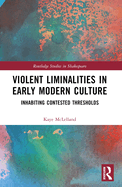
Violent Liminalities in Early Modern Culture: Inhabiting Contested Thresholds
Rent this book
Free return shipping includedPlease Note: Rental books are typically used and do not come with any unused access code cards.
Buy from a seller
About this book
Violent liminalities in Early Modern Culture is a methodologically innovative book combining the twin disciplines of queer theory and disability studies. It investigates the violence feared from, and directed at, inhabitants of the 'betwixt and between' spaces of early modern literature and culture, through a focus on the perpetuated metamorphic states of Shakespeare's and Spenser's liminal figures including Lavinia, Puck, and Britomart. With chapters on gender, sexuality, adolescence, madness, and physical disability, Kaye McLelland applies a bi-theoretical lens to interrogate the ways in which being simultaneously 'neither' and 'both' brings to bear the non-normative disruption identified by queer theory in ways that use binary systems against themselves. For many of Spenser's and Shakespeare's characters, the 'in-between' state, whether ritually or otherwise induced, transforms the instantaneous binary threshold of the limen into a permanent 'habitation'. This created space is one of great power that is feared and violently countered by those who would shut it down. Set against the literary history of Spenser's and Shakespeare's Ovidianism and festivity, and the historical context of the post-Reformation transformation from a tertiary to a binary model of the afterlife, this volume identifies a persistent positioning of liminal literary figures in proximity to the liminality of the dead and dying, whilst simultaneously tracing the positive ways in which these inhabitants of the powerful 'betwixt and between' are depicted.