
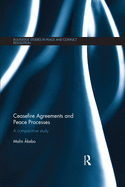
Ceasefire Agreements and Peace Processes: A Comparative Study
Rent this book
Free return shipping includedPlease Note: Rental books are typically used and do not come with any unused access code cards.
Buy from a seller
About this book
This book analyses and compares ceasefire agreements as part of peace processes in intrastate armed conflicts.
Research repeatedly underscores the importance of ceasefire agreements in peace processes but suggests that they can influence such processes in fundamentally different ways. However, despite contradictory expectations, remarkably few studies have so far been devoted to systematic and in-depth analysis of ceasefire agreements in contemporary intrastate armed conflicts. This book contributes to filling this gap by using a process-oriented conflict dynamics approach to analyse and explain how ceasefire agreements are being influenced by and in turn influences the broader dynamics of peace processes. Empirically, the book focuses on the armed conflicts in Aceh (Indonesia) and Sri Lanka. Based on document studies and 57 interviews with key actors, it presents comparative insights and in-depth knowledge about ceasefire agreements in different contextual settings. The book problematizes the common assumption in the literature that ceasefire agreements create momentum in peace processes and pave the way to peace, and it provides a more nuanced analysis and understanding based on two empirical cases analysed within a comparative framework. In contrast to conventional wisdom, it demonstrates how ceasefires on the contrary also can have negative implications on peace processes.
This book will be of much interest to students of conflict resolution, peace studies, intra-state conflict, security studies and IR in general.