
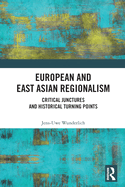
European and East Asian Regionalism: Critical Junctures and Historical Turning Points
Rent this book
Free return shipping includedPlease Note: Rental books are typically used and do not come with any unused access code cards.
Buy from a seller
About this book
Embedded in the evolving comparative regionalism literature, this book offers a systematic analysis of the factors positively and negatively influencing regional institution-building.
The ruptures caused by the Eurozone crises, the coronavirus pandemic and by Brexit have renewed the interest in the impact of crises and critical junctures on regionalism here defined as regional institution-building. Drawing from critical juncture research and historical comparative analysis, this volume uses the cases of European and East Asian regional institution-building to systematically analyse institutional transformations during specific historical turning points and critical juncture moments. Wunderlich's research offers an in-depth analysis of the interrelated drivers, spoilers and dissolvers of regional institution-building processes in Europe and East Asia, and addresses key questions including: Under what conditions does regionalism take hold? What is influencing the initial institutional design choices? What is the impact of historical experiences and well-entrenched norms and ideas? What are the roles of regional leaders? How do external factors influence regional institution-building? What turns a crisis into a critical juncture and are such junctures threats or opportunities? What accounts for variations in institutional responses to crisis events across different regional settings?
This book will be a valuable resource for scholars of regionalism, region-building, regional governance and international relations of Europe and East Asia.