
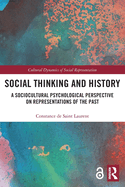
Social Thinking and History: A Sociocultural Psychological Perspective on Representations of the Past
Rent this book
Free return shipping includedPlease Note: Rental books are typically used and do not come with any unused access code cards.
Buy from a seller
About this book
Social Thinking and History demonstrates that our representations of history are constructed through complex psychosocial processes in interaction with multiple others, and that they evolve throughout our lifetime, playing an important role in our relation to our social environment.
Building on the literature on social thinking, collective memory, and sociocultural psychology, this book proposes a new perspective on how we understand and use our collective past. It focuses on how we actively think about history to construct representations of the world within which we live and how we learn to challenge or appropriate the stories we have heard about the past. Through the analysis of three studies of how history is understood and represented in different contexts - in political discourses in France, by intellectuals and artists in Belgium, and when discussing a current event in Poland - its aim is to offer a rich picture of our representations of the past and the role they play in everyday life.
This book will be of great interest toacademics, researchers, and postgraduate students in the fields of psychology, memory studies, sociology, political science, and history. It will also make an interesting read for psychologists and human and social scientists working on collective memory.