
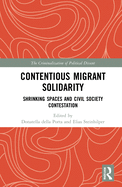
Contentious Migrant Solidarity: Shrinking Spaces and Civil Society Contestation
Rent this book
Free return shipping includedPlease Note: Rental books are typically used and do not come with any unused access code cards.
Buy from a seller
About this book
In the context of both the financial crisis and the crisis of European migration politics, the notion of solidarity has gained renewed prominence and - as this book argues - its practice has become increasingly contentious. Intersecting crises have sharpened social and political polarization and have contracted simultaneously the space for migrant and minority rights as well as the rights around political dissent.
Building upon social movement and migration studies, this book maps the two sides of 'contentious solidarity' a shrinking civic space and its contestation by civil society. The book thereby unfolds the variety of repressive means (physical, legal, administrative and discursive) employed by governmental and non-governmental bodies against migrant solidarity, but also looks at how civil society organizations react to these restrictions through at times moderation and at times increasing contention. The diagnosis of 'contentious solidarity' is located within two broader trends affecting the relationship between the state and civil society in a neoliberal context in general and since the financial crisis in particular.
Bridging studies on social movement studies and civil society organizations, this volume contributes to recent reflections on repression of social movements as well as of a hybridization of civil society organizations. Given its broad scope and the utmost timeliness of the issues it addresses, the volume will be of interest to a broad academic and non-academic audience.