
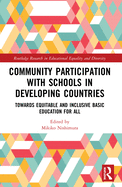
Community Participation with Schools in Developing Countries: Towards Equitable and Inclusive Basic Education for All
Rent this book
Free return shipping includedPlease Note: Rental books are typically used and do not come with any unused access code cards.
Buy from a seller
About this book
The Sustainable Development Goals (SDGs) (2016-2030) set by the United Nations in 2015 restated the importance of universal primary education for all, and specifically discuss quality, equity, and inclusion in basic education. To achieve this, the role of community has been emphasized and participation has become a "buzzword" in international development over the past several decades. Despite the growing attention to community participation in school management, previous literature has shown mixed results in terms of its actual practice and its impacts on quality, equity, and inclusion in education.
This book deepens the contextual understanding of community in developing countries and its involvement in schools in general, and its impact on quality, equity, and inclusion of school education in particular. By presenting various case studies in Asia, Africa, Latin America, and a post-conflict state in Europe, the book analyses commonalities and differences in the ways communities are involved and cast their impacts and challenges. The book contributes knowledge on the ways in which community involvement could work in developing countries, the detailed processes and factors that make community participation work in different dimensions, and remaining challenges that scholars and practitioners still need to be concerned and mindful in the field.
This book will appeal to both researchers and practitioners who are concerned about the community participation approach for the SDGs.