
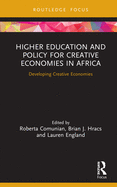
Higher Education and Policy for Creative Economies in Africa: Developing Creative Economies
Rent this book
Free return shipping includedPlease Note: Rental books are typically used and do not come with any unused access code cards.
Buy from a seller
About this book
The book reflects on the role of the creative economies in a range of African countries (namely Ghana, Kenya, Nigeria, South Africa and Uganda). Chapters explore how creative economies emerge and can be supported in African countries.
The contributors focus on two key dimensions: the role of higher education and the role of policy. Firstly, they consider the role of higher education and alternative forms of specialised education to reflect on how the creative aspirations of students (and future creative workers) of these countries are met and developed. Secondly, they explore the role of policy in supporting the agendas of the creative economy, taking also into consideration the potential historical dimension of policy interventions and the impact of a lack of policy frameworks. The book concludes by reflecting on how these two pillars of creative economy development, which are usually taken for granted in studying creative economies in the global north, need to be understood with their own specificity in the context of our selected case studies in Africa.
This book will be of interest to students, scholars and professionals researching the creative economies in Africa across the humanities and social sciences.
All the royalties from the publication of this book will be donated to the not-for-profit organisation The Craft and Design Institute (CDI) (https: //www.thecdi.org.za/) in South Africa, supporting capacity building for young creative practitioners from disadvantaged backgrounds.