
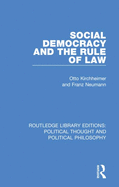
Social Democracy and the Rule of Law
Rent this book
Free return shipping includedPlease Note: Rental books are typically used and do not come with any unused access code cards.
Buy from a seller
About this book
First published in 1987. The legal and political writings of the German Social Democrats Kirchheimer and Neumann, from the period prior to the National Socialist seizure of power, are little known to English readers. This volume presents a selection of important essays from this period, which focus on the prospects for the constitutional realization of a social democratic order in the first German Republic - the Weimar Republic, created out of the collapse of the monarchy in 1918, and destroyed by the National Socialists in 1933.
Both Kirchheimer and Neumann were active as lawyers in the later 1920s and early 1930s, the latter especially having a close connection with trade union legislation and labour law. From their viewpoint as Social Democrats and lawyers they present incisive analyses of the problems confronted by the attempt to realize the ideal of a social Rechtsstaat in a political environment increasingly dominated by forces on left and right which saw constitutional order only as a means to seize power, and not as a legitimate form of order in itself. In these circumstances, political issues translated into constitutional issues, and thus could be analysed in terms of the aims and objectives of a given constitutional order.
A substantial introduction by the volume's editor, Keith Tribe, presents the political and theoretical background to these essays, which range over questions of industrial democracy, political representation, parliamentary rule and the role of judicial review. These issues are once more on the political agenda of Western industrial democracies, and the analyses of Kirchheimer and Neumann have lost none of their force and relevance, despite the catastrophic 'failure' of Weimar democracy in 1933.