
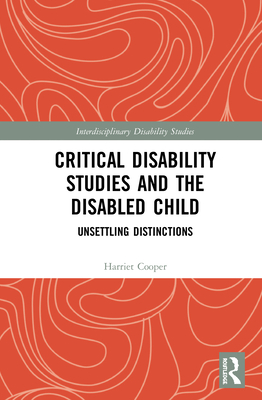
Critical Disability Studies and the Disabled Child: Unsettling Distinctions
Rent this book
Free return shipping includedPlease Note: Rental books are typically used and do not come with any unused access code cards.
Buy from a seller
About this book
This book examines the relationship between contemporary cultural representations of disabled children on the one hand, and disability as a personal experience of internalised oppression on the other. In focalising this debate through an exploration of the politically and emotionally charged figure of the disabled child, Harriet Cooper raises questions both about what it means to 'speak for' the other and about what resistance means when one is unknowingly invested in one's own abjection.
Drawing on both the author's personal experience of growing up with a physical impairment and on a range of critical theories and cultural objects - from Frances Hodgson Burnett's novel The Secret Garden to Judith Butler's work on injurious speech - the book theorises the making of disabled and 'rehabilitated' subjectivities. With a conceptual framework informed by both psychoanalysis and critical disability studies, it investigates the ways in which cultural anxieties about disability come to be embodied and lived by the disabled child.
Posing new questions for disability studies and for identity politics about the relationships between lived experiences, cultural representations and dominant discourses - and demonstrating a new approach to the concept of 'internalised oppression' - this book will be of interest to scholars and students of disability studies, medical humanities, sociology and psychosocial studies, as well as to those with an interest in identity politics more generally.