
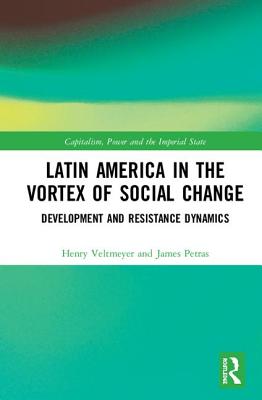
Latin America in the Vortex of Social Change: Development and Resistance Dynamics
Rent this book
Free return shipping includedPlease Note: Rental books are typically used and do not come with any unused access code cards.
Buy from a seller
About this book
This book explores the dynamics of the recent 'progressive cycle' in Latin American politics, associated with a red and pink tide of regime change. With this cycle of centre-left regimes oriented towards an alternative post-neoliberal form of development now coming to an end, coinciding with the end of a 'primary commodities boom' (the demand for natural resources exported in primary form on the world market), the authors seek to explore the dynamics of the transition from a progressive cycle of regimes oriented towards the search for a more inclusive form of development towards what appears to be another swing in the pendulum of electoral politics towards the far right and a return to neoliberal orthodoxy.
Within the vortex of forces of change pushing towards both the Left and the Right, Latin America lies at the centre of ongoing heated theoretical and political debates as to how to bring about a more inclusive and sustainable form of post-neoliberal and post-capitalist development. Latin America in the Vortex of Social Change crucially aims to cut through these debates and explore the dynamics of the forces of change at work in the current conjuncture of capitalist development. With reference to a theoretical framework based on the interaction of three different forms of capitalism (capitalism as usual, extractive capitalism, narco-capitalism), the authors proceed to an analysis of the development and resistance dynamics of the development process that is unfolding on the Latin American political landscape. The book will appeal to scholars of political sociology and political theory with an interest in the political economy of development and Latin American affairs.