
Home / Search / Social Change and the Coming of Post-consumer Society: Theoretical Advances and Policy Implications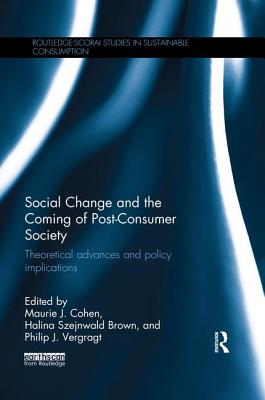
ISBN-13 · 9780367030216ISBN-10 · 0367030217Publisher · RoutledgeFormat · Trade Paperback, 234 pagesPublished · 2019Language · English
Social Change and the Coming of Post-consumer Society: Theoretical Advances and Policy Implications
Rent this book
Free return shipping includedTotal rental price$38.92
Please Note: Rental books are typically used and do not come with any unused access code cards.
Return by 2026-10-26. Prepaid return label included; extend at any point for the difference in price.
Buy from a seller
Bookface-OutletShips from CA
GoodTypical used book with minor wear and signs of use. May have some highlighting or writing.
97.43
About this book
Consumer society is an unquestionably complex social construct. However, after decades of unremitting dominance there are signs emerging that it is starting to falter, both as a coherent and durable system of social organization and as a strategy for societal advancement. Debates concerning how we can transition beyond present energy- and materials-intensive consumer society are beginning to gain greater salience.
Social Change and the Coming of Post-Consumer Society
aims to develop more complete appreciation of the relevant processes of social change and to identify effective interventions that could enable a transition to supersede consumer society. Bringing together leading interdisciplinary experts on social change, the book identifies and analyzes several ongoing small- and modest-scale social experiments. Possibilities for macro-scale change from the interlinked perspectives of culture, economics, finance, and governance are then explored. These contributions expose the systemic problems that are emblematic of the current condition of consumer society, specifically the unsustainability of prevailing consumption practices and lifestyles and the persistence of inequalities. These observations are summarized and extended in the final chapter of the book.This volume will be of great interest to students and scholars of sustainable consumption, sustainability transitions, environmental sociology, and sustainable development.