
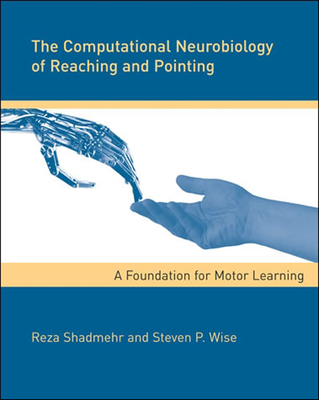
The Computational Neurobiology of Reaching and Pointing: A Foundation for Motor Learning
Rent this book
Free return shipping includedPlease Note: Rental books are typically used and do not come with any unused access code cards.
Buy from a seller
About this book
Neuroscience involves the study of the nervous system, and its topics range from genetics to inferential reasoning. At its heart, however, lies a search for understanding how the environment affects the nervous system and how the nervous system, in turn, empowers us to interact with and alter our environment. This empowerment requires motor learning. The Computational Neurobiology of Reaching and Pointing addresses the neural mechanisms of one important form of motor learning. The authors integrate material from the computational, behavioral, and neural sciences of motor control that is not available in any other single source. The result is a unified, comprehensive model of reaching and pointing. The book is intended to be used as a text by graduate students in both neuroscience and bioengineering and as a reference source by experts in neuroscience, robotics, and other disciplines.
The book begins with an overview of the evolution, anatomy, and physiology of the motor system, including the mechanisms for generating force and maintaining limb stability. The sections that follow, "Computing Locations and Displacements", "Skills, Adaptations, and Trajectories", and "Predictions, Decisions, and Flexibility", present a theory of sensorially guided reaching and pointing that evolves organically based on computational principles rather than a traditional structure-by-structure approach. The book also includes five appendixes that provide brief refreshers on fundamentals of biology, mathematics, physics, and neurophysiology, as well as a glossary of relevant terms. The authors have also made supplemental materials available on the Internet. These web documents provide source code for simulations, step-by-step derivations of certain mathematical formulations, and expanded explanations of some concepts.