
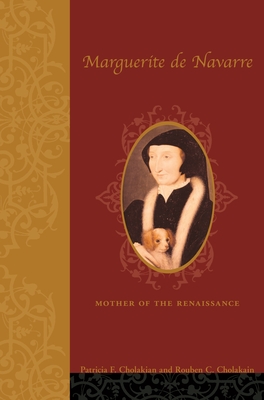
Marguerite de Navarre (1492-1549): Mother of the Renaissance
Rent this book
Free return shipping includedPlease Note: Rental books are typically used and do not come with any unused access code cards.
Buy from a seller
About this book
Sister to the king of France, queen of Navarre, gifted writer, religious reformer, and patron of the arts--in her many roles, Marguerite de Navarre (1492-1549) was one of the most important figures of the French Renaissance. In this, the first major biography in English, Patricia F. Cholakian and Rouben C. Cholakian draw on her writings to provide a vivid portrait of Marguerite's public and private life. Freeing her from the shadow of her brother Fran�ois I, they recognize her immense influence on French politics and culture, and they challenge conventional views of her family relationships.
The authors highlight Marguerite's considerable role in advancing the cause of religious reform in France-her support of vernacular translations of sacred works, her denunciation of ecclesiastical corruption, her founding of orphanages and hospitals, and her defense and protection of persecuted reformists. Had this plucky and spirited woman not been sister to the king, she would most likely have ended up at the stake. Though she remained a devout catholic, her theological poem Miroir de l'�me p�cheresse, a mystical summa of evangelical doctrine that was viciously attacked by conservatives, remains to this day an important part of the Protestant corpus.
Marguerite, along with her brother the king, was a key architect and animator of the refined entertainments that became the hallmark of the French court. Always eager to encourage new ideas, she supported many of the illustrious writers and thinkers of her time. Moreover, uniquely for a queen, she was herself a prolific poet, dramatist, and prose writer and published a two-volume anthology of her works. In reassessing Marguerite's enormous oeuvre, the authors reveal the range and quality of her work beyond her famous collection of tales, posthumously called the Heptam�ron.
The Cholakians' groundbreaking reading of the rich body of her work, which uncovers autobiographical elements previously unrecognized by most scholars, and their study of her surviving correspondence portray a life that fully justifies Marguerite's sobriquet, "Mother of the Renaissance."