
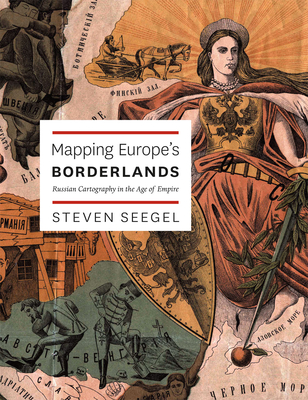
Mapping Europe's Borderlands: Russian Cartography in the Age of Empire
Rent this book
Free return shipping includedPlease Note: Rental books are typically used and do not come with any unused access code cards.
Buy from a seller
About this book
The simplest purpose of a map is a rational one: to educate, to solve a problem, to point someone in the right direction. Maps shape and communicate information, for the sake of improved orientation. But maps exist for states as well as individuals, and they need to be interpreted as expressions of power and knowledge, as Steven Seegel makes clear in his impressive and important new book.Mapping Europe's Borderlands takes the familiar problems of state and nation building in eastern Europe and presents them through an entirely new prism, that of cartography and cartographers. Drawing from sources in eleven languages, including military, historical-pedagogical, and ethnographic maps, as well as geographic texts and related cartographic literature, Seegel explores the role of maps and mapmakers in the East Central European borderlands from the Enlightenment to the Treaty of Versailles. For example, Seegel explains how Russia used cartography in the aftermath of the Napoleonic Wars and, later, formed its geography society as a cover for gathering intelligence. He also explains the importance of maps to the formation of identities and institutions in Poland, Ukraine, and Lithuania, as well as in Russia. Seegel concludes with a consideration of the impact of cartographers' regional and socioeconomic backgrounds, educations, families, career options, and available language choices.